Chatham Village by Angelique Bamberg
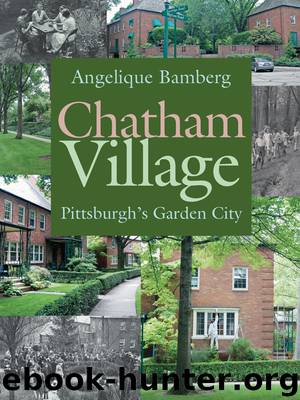
Author:Angelique Bamberg
Language: eng
Format: epub
ISBN: 9780822980704
Publisher: University of Pittsburgh Press
five
A Demonstration, Not a Revolution
In 1955, Charles Lewis declared that the Buhl Foundation's objectives for Chatham Village “have been fully realized.”1 Lewis's claim was in some regards an overstatement, but Chatham Village was extraordinarily successful: high occupancy rates, low tenant turnover, and long waiting lists for units have been steady characteristics of the community since the day it opened in 1932. Through economic depression, war, and inflation, the community continued to bring the Buhl Foundation a stable annual return in excess of 4 percent until it was sold to its tenants in 1960. Catherine Bauer lauded Chatham Village as “probably the best example of modern planned housing in the country.”2 Yet despite its self-contained success, Lewis's experiment did not succeed in revolutionizing residential design in America. In the initial flurry of enthusiasm surrounding its construction, a few imitations were built, but nothing approaching the large-scale replication its creators envisioned and expected.
Today, Chatham Village's secluded site and an unspoken understanding among its residents conspire to make it one of the best-kept housing secrets in Pittsburgh. But, especially in the first ten years after its construction, Chatham Village was anything but obscure. The swiftness with which residents rented units and the fact that the housing plan made money for the Buhl Foundation caught the attention of business executives and investors, while the succinct elegance of its design led the emerging public housing movement to cite it as an exemplar of what good housing could be. Tenants and critics alike extolled the planned community's amenities, and few disagreed that it was a desirable place to live. From the announcement of the Buhl Foundation's plans through the start of World War II, Chatham Village was a celebrated as a model and inspiration for architects, planners, developers, and investors.
Its renown must largely be attributed to the inexhaustible efforts of Charles Lewis to advocate for the Chatham Village model and the ability of private capital to solve America's slum-housing crisis. Lewis hired a public relations firm to promote the demonstration project and called upon his own skills as a newspaper editor to campaign for a favorable public response.3 He commissioned models and a motion picture of Chatham Village and toured conferences with them. Whenever possible, Lewis recruited Clarence Stein and Henry Wright to join him in personally addressing delegates on the virtues of planned communities.
The most prominent and influential of these conferences was Herbert Hoover's President's Conference on Home Building and Home Ownership held in December 1931. Delegates at this gathering paid considerable attention to Stein and Wright's plans for Radburn as well as for Chatham Village. They focused not only on the innovative design and attractive amenities of these communities, but on the economics of large-scale operations and planning housing in groups that allowed them to be built economically and efficiently. As a result, the final recommendations of the conference were favorable toward the construction of large-scale, comprehensively planned communities of grouped rental housing and detached, owner-occupied dwellings alike.
Download
This site does not store any files on its server. We only index and link to content provided by other sites. Please contact the content providers to delete copyright contents if any and email us, we'll remove relevant links or contents immediately.
| Anthropology | Archaeology |
| Philosophy | Politics & Government |
| Social Sciences | Sociology |
| Women's Studies |
Nudge - Improving Decisions about Health, Wealth, and Happiness by Thaler Sunstein(7758)
The Fire Next Time by James Baldwin(5501)
iGen by Jean M. Twenge(5453)
Adulting by Kelly Williams Brown(4621)
The Sports Rules Book by Human Kinetics(4448)
The Hacking of the American Mind by Robert H. Lustig(4423)
The Ethical Slut by Janet W. Hardy(4306)
Captivate by Vanessa Van Edwards(3858)
Mummy Knew by Lisa James(3725)
In a Sunburned Country by Bill Bryson(3578)
The Worm at the Core by Sheldon Solomon(3510)
Ants Among Elephants by Sujatha Gidla(3494)
The 48 laws of power by Robert Greene & Joost Elffers(3380)
Get What's Yours for Medicare: Maximize Your Coverage, Minimize Your Costs by Philip Moeller(3091)
Suicide: A Study in Sociology by Emile Durkheim(3045)
The Slow Fix: Solve Problems, Work Smarter, and Live Better In a World Addicted to Speed by Carl Honore(3037)
The Tipping Point by Malcolm Gladwell(2961)
Humans of New York by Brandon Stanton(2905)
Handbook of Forensic Sociology and Psychology by Stephen J. Morewitz & Mark L. Goldstein(2738)
